
KAMIAOYAGI MODEL
Four Seasons Material Yamaniwa
Also known as: Maeyama Garden (Pocket Garden)
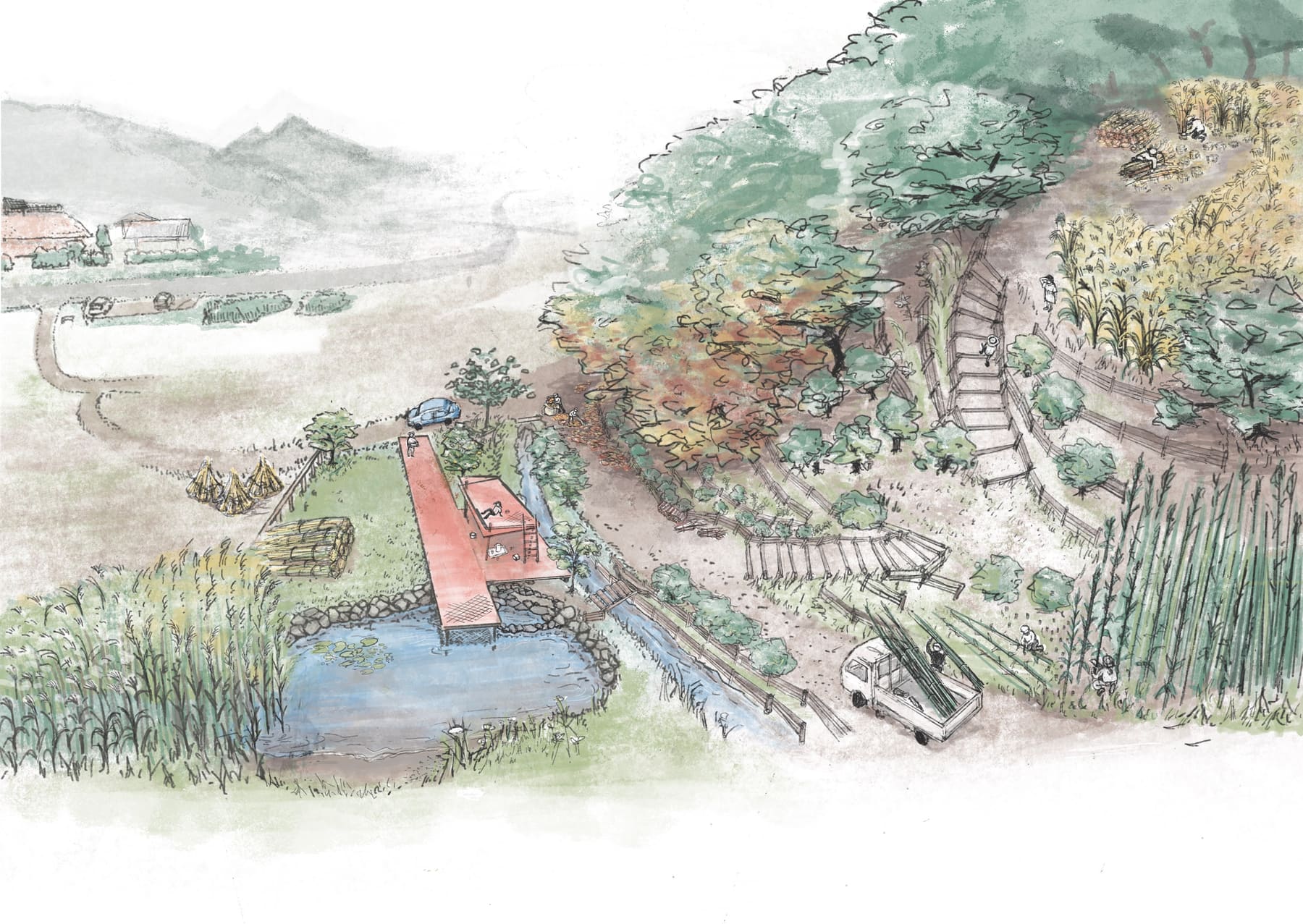
Rice terraces and slopes that went wild when people stopped tending them, now being shaped into a garden people enter to harvest materials. A place to learn, by stepping in and lending a hand, how to live with plants, flowers, soil, stone and water. The first phase of work is complete, and the garden has entered a stage of daily care and making materials.
The garden lies on land belonging to the owner of Obaachan-chi. Terraces and woodland that became abandoned farmland, when the old bond between nature and people in the satoyama broke, are being restored through planting, soil improvement and environmental earthworks.
Each of its five areas has a role. In the Kayaba we grow Japanese silver grass for thatched roofs; on the Shamen slope we cut back dwarf-bamboo thickets and plant fruit trees and tea. Along the Ogawa stream, collapsing banks are rebuilt in steps with log retaining walls, and the Shitchi returns old paddies and channels to a waterside habitat. The Terrace at the entrance is where harvested materials are processed and loaded, a place to rest, and a lookout over the village.
The Kayaba is also a maintenance base for the Yasato Thatched Roof Preservation Society, and the grass cut there goes to repair nearby thatched houses. Over the hill, local residents are working to bring back fireflies, and in the paddy next door YASABI grows rice.
It is more than a source of materials. It is a park-like place where even people new to the satoyama can feel in touch with nature, and a walking path for local people. In future it will also become a place to gather fruit for a while.
STEPS
How we work
- KayabaRestore the silver-grass field. Improve the soil to hold back goldenrod, and use the grass for thatch
- ShamenCut the dwarf-bamboo thickets and coppice the oaks. Plant fruit and tea, with log retaining walls on steep parts
- OgawaRemove the weed sheets and rebuild the banks in steps with log stakes and crossbars, so soil stops washing away
- ShitchiTurn old paddies and channels into water up to 40 cm deep, a habitat with reeds, wild rice and a stone bank
- TerraceA work and rest area at the entrance, with trees for shade and fruit, and trees that bring birds that eat rice pests
CALENDAR
The year in the garden: harvest, observation, care
Winter, when cutting grass and bamboo overlaps with gathering firewood, is the season for making materials. From May to December, fruit and tea leaves are harvested in turn, from blueberries to yuzu.
| Month | Fruit & food | Flowers | Kayaba (silver grass) | Paddy (rice & straw) | Shino field (arrow bamboo) | Trees | Grasses |
|---|---|---|---|---|---|---|---|
| Jan | Cutting | Cutting | Firewood | ||||
| Feb | Tilling | Cutting | Pruning, felling for firewood | ||||
| Mar | |||||||
| Apr | Rice planting | ||||||
| May | Blueberries | Azaleas bloom | Care | Cutting bamboo, mowing | |||
| Jun | Blueberries | Weeding, water management | Thinning | ||||
| Jul | Kudzu leaves | ||||||
| Aug | Tea leaves | ||||||
| Sep | Lemons, persimmons | Tea flowers bloom | Rice harvest | Pruning, felling for firewood | |||
| Oct | Mandarins, pomegranates | Maples turn red | Gathering leaves | Gathering leaves | |||
| Nov | Tilling | Firewood, gathering leaves | Gathering leaves | ||||
| Dec | Yuzu | Cutting | Harvesting | Firewood |
DATA
| Location | Kamiaoyagi, Ishioka, Ibaraki (on the land of Obaachan-chi's owner) |
|---|---|
| Award | Green Environment Plan Grand Prize, The Dai-ichi Life Foundation |
| Materials | Silver grass and dwarf bamboo (thatch) / shimagaya grass and rice straw (thatch, landscaping) / reed and silver reed (thatch) / fallen leaves (repairing paddy ridges, landscaping) / branches and logs (retaining walls, firewood) / fruit and tea |
| Planting | Mandarin, lemon, pomegranate, hyuganatsu, juneberry, Japanese pepper, tea, and waterside plants such as reed, silver reed, wild rice and cattail |
| Shared with | Yasato Thatched Roof Preservation Society |
| Landscaping | Negishi |
| Status | First phase complete |
Take part in or support this project
Ways to join